

Stock Market vs. Gambling: Exposing the Biggest Myth for Good
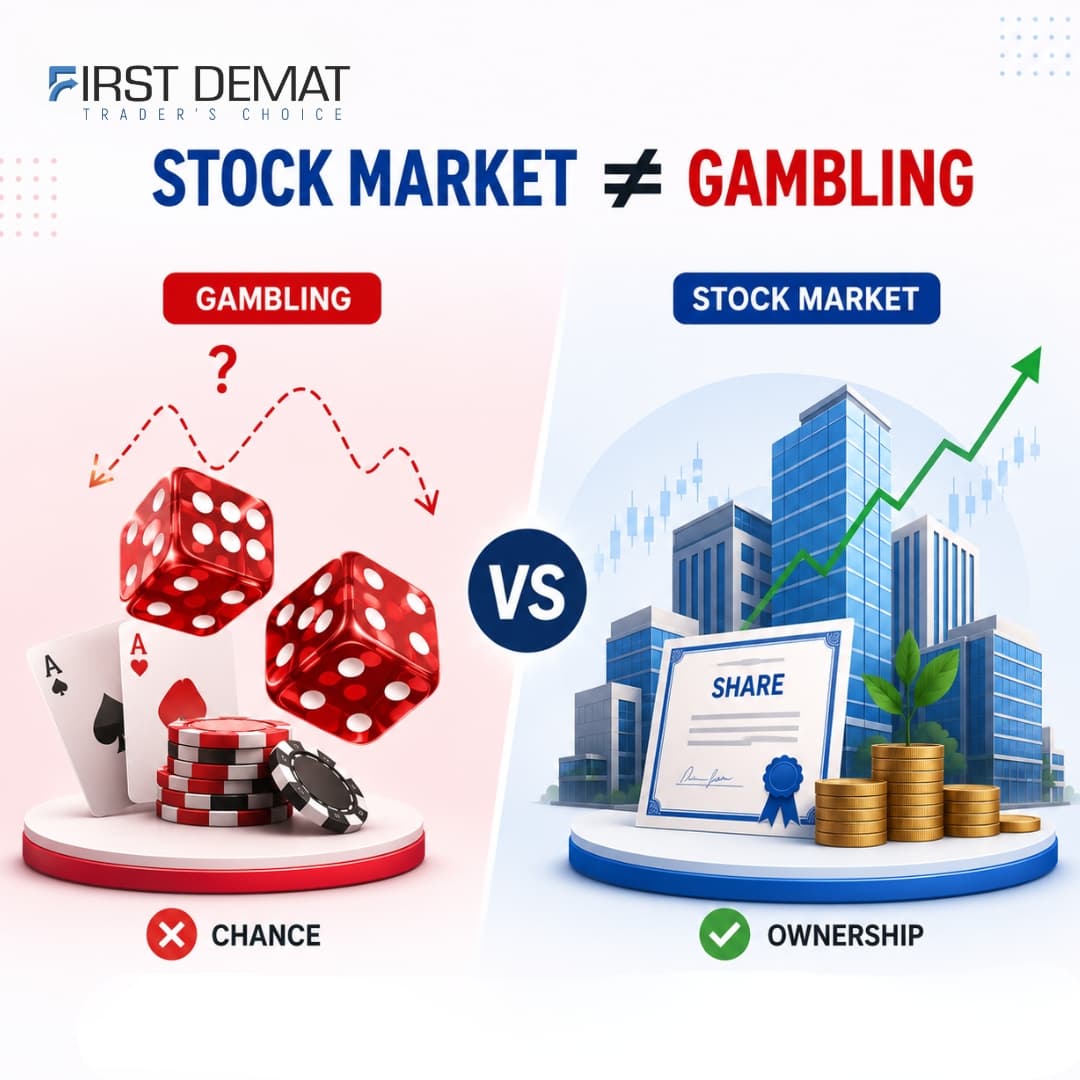
"Stock market is just gambling with extra steps."
If you have ever thought about investing, chances are someone in your life has said this to you. And honestly, it sounds convincing at first. Both involve money, both involve risk and both can make you rich or wipe you out overnight. So why do we keep saying they are different?
Let's break this myth down, once and for all.
What Gambling Actually Is
Gambling is a zero-sum game built on random chance. Think of a casino's roulette wheel or a card game. The outcome has nothing to do with skill, research or time. It is pure luck.
Here's the key part people miss: gambling does not create anything. If you win ₹10,000 at a casino, that money did not appear out of thin air. It came directly from someone else's pocket who lost it. No value was created in the process. The house also takes a cut, so over time, the odds are mathematically designed against you.
What Stock Investing Actually Is
When you buy a share of a company, you are not placing a bet. You are buying a fractional ownership in a real, functioning business. That business sells products, earns revenue, pays employees and tries to grow profits year after year.
When the company does well, the value of your ownership grows too. This is not random chance. It depends on real factors like the company's management, its products, its competition and the broader economy. This is why investing rewards research and patience, while gambling rewards nothing but luck.
In short, the stock market is not a closed pool of money where one person's gain is another's loss. As businesses grow and the economy expands, the entire pie gets bigger. Everyone holding a piece of that pie can benefit at the same time.
Stock Market vs. Gambling: Quick Comparison
Factor | Gambling | Stock Investing |
What you own | Nothing, just a bet on an outcome | A real share in a business |
Source of returns | Someone else's loss | Business growth and profits |
Role of skill | None, pure chance | Research, analysis and patience matter |
Time horizon | Instant outcome | Grows meaningfully over years |
Value creation | None, money just moves | New value is created as businesses grow |
Odds | Mathematically against you | Historically favour long-term investors |
A Real-Life Example
Let's say you buy one share of a company like Hindustan Unilever. Every time someone buys soap, shampoo or tea made by this company, the business earns revenue. Some of this revenue becomes profit and a part of that profit may come to you as a dividend. Over the years, as the company sells more and expands into new markets, the value of your share tends to rise too.
Now compare this to placing ₹10,000 on a single hand of cards. There is no business behind it, no product being sold and no future growth to look forward to. Once the round ends, the money has either multiplied or vanished, with nothing left to show for it either way.
This is the real difference. One is tied to a real, productive asset. The other is tied to nothing but a random number.
Why This Myth Refuses to Die
The confusion mostly comes from short-term trading behaviour. When people buy stocks for quick gains and sell within days based on tips or rumours, they are not really investing. They are speculating, which does start to resemble gambling. This is also why intraday trading and F&O (Futures and Options) carry a much higher risk profile compared to long-term equity investing.
But this is a difference in approach, not in the asset itself. A car can be driven safely or recklessly. That does not make the car dangerous by design.
FAQs
1. Is intraday trading the same as gambling?
- Not exactly the same, but it carries similar risk patterns since decisions are based on short-term price movements rather than business fundamentals.
2. Can I lose all my money in stocks like I can in gambling?
- Yes, if you invest in a single, poorly researched stock without any diversification. This is why diversification and long-term thinking matter.
3. Why do stock returns feel unpredictable in the short term?
- Short-term prices are influenced by sentiment and news, but over the long run, they tend to follow the company's actual performance.
4. Is there any guarantee of returns in the stock market?
- No. Unlike fixed deposits, stock returns are never guaranteed. However, historical data shows that quality businesses tend to grow in value over long periods.
5. What makes long-term investing different from speculation?
- Long-term investing is based on a company's fundamentals and growth potential, while speculation is based on short-term price predictions or tips.
The Bottom Line
Gambling and investing might look similar on the surface because both involve risk and uncertainty. But one is built on random luck with no value creation, while the other is built on owning a piece of a real, growing business. Once you understand this difference, the fear around investing starts to fade and a clearer, more confident approach takes its place.