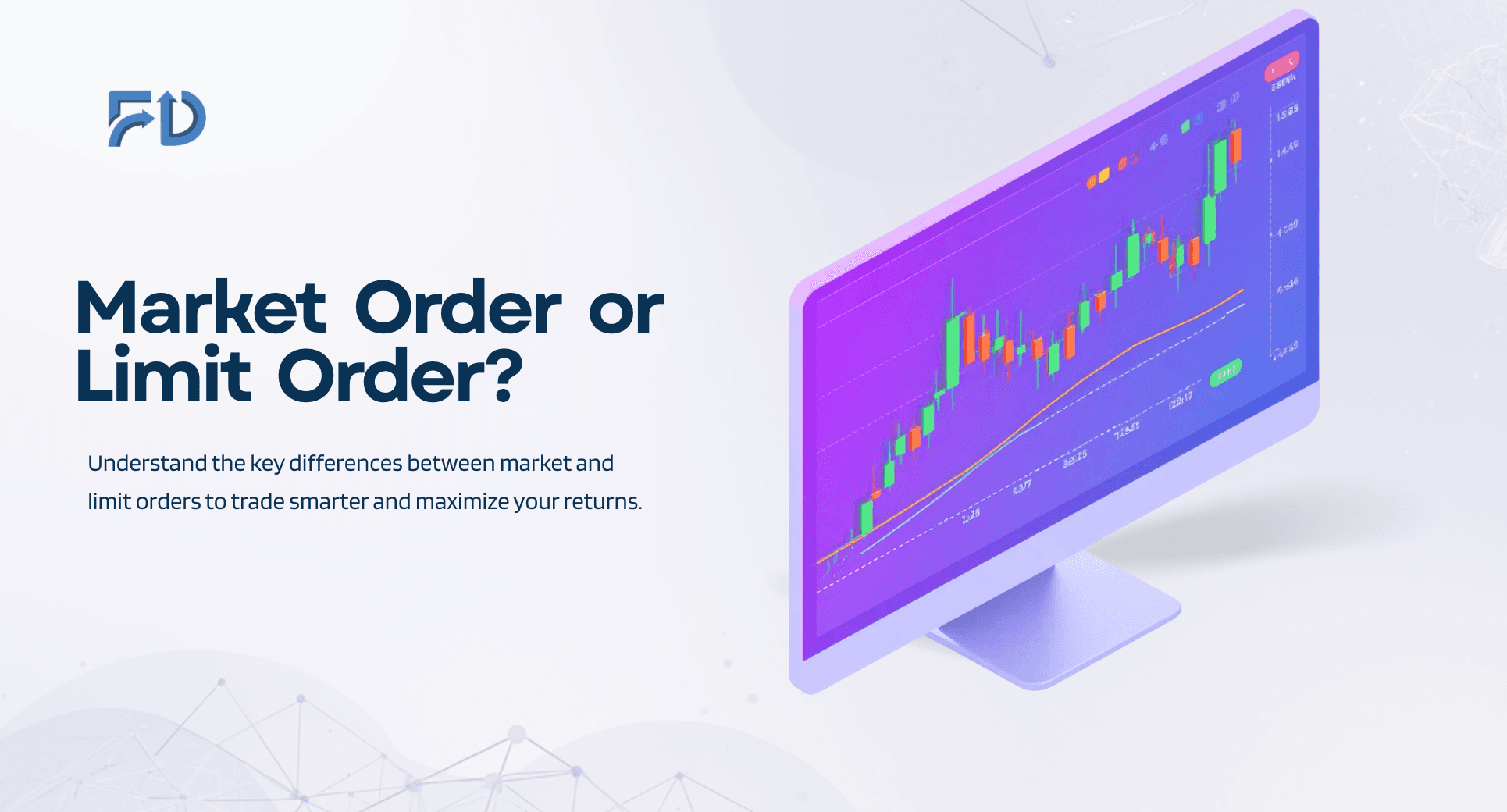
You have opened your demat account, done your research and decided you want to buy shares of a company. You tap "Buy" on your trading app and suddenly you see two options staring back at you: Market Order and Limit Order.
Most beginners just pick the first one and move on. But knowing the difference between these two can save you money and prevent some frustrating surprises. Let's break it down.
What Is a Market Order?
A market order is the simplest type. When you place a market order, you are telling the exchange: "Buy me this stock right now, at whatever the current price is."
You do not get to choose the price. The trade executes immediately at the best available price in the market at that moment.
Think of it like walking into a shop and saying, "I'll take one, whatever it costs." You get the item fast but you have no control over what you pay.
Example: Priya Places a Market Order
Priya checks First Demat and sees that Infosys is trading at ₹1,500 per share. She places a market order for 10 shares.
By the time her order reaches the exchange, the price has moved to ₹1,503. She ends up buying all 10 shares at ₹1,503 each instead of ₹1,500.
That ₹3 difference per share does not sound like much but on larger quantities or volatile stocks, it can add up quickly. This difference between the expected price and the actual execution price is called slippage.
What Is a Limit Order?
A limit order lets you set the exact price at which you want to buy or sell. You are telling the exchange: "Buy this stock, but only if the price comes down to ₹X or lower."
If the stock never reaches your price, the order simply does not execute. You stay in control but you may have to wait or miss the trade entirely.
Think of it like placing a bid at an auction. You set your maximum price and wait to see if the seller agrees.
Example: Ramesh Places a Limit Order
Ramesh sees HDFC Bank is trading at ₹770. He thinks that is a bit expensive and sets a limit order at ₹760.
Two scenarios can play out:
Scenario A: The stock dips to ₹760 during the day. His order triggers and he buys at exactly his target price.
Scenario B: The stock stays above ₹760 all day. His order does not execute and he ends the day without any shares but also without overpaying.
Market Order vs. Limit Order: Side by Side
Feature | Market Order | Limit Order |
Execution speed | Immediate | Only when price is met |
Price control | None | Full control |
Risk of slippage | Yes | No |
Risk of not executing | None | Yes |
Best used when | You need to buy fast | You want a specific price |
Suits which stocks | High-volume, stable stocks | All stocks, especially volatile ones |
When Should You Use Which?
Use a market order when:
You are buying a large, highly traded stock like Reliance or TCS where the price is stable and the difference between buy and sell price (called the bid-ask spread) is very small. Speed matters more than a few rupees.
Use a limit order when:
You are buying a mid-cap or small-cap stock where prices can swing a lot. Or when you have a budget in mind and do not want to spend even a rupee more than your target.
For most beginners in India, limit orders are the safer and more disciplined choice.
A Quick Word on the Bid-Ask Spread
Every stock on the NSE or BSE has two prices at any moment:
Bid price - the highest price a buyer is currently willing to pay
Ask price - the lowest price a seller is currently willing to accept
The gap between these two is the bid-ask spread. When you place a market order to buy, you pay the ask price. The wider the spread, the more you can overpay without realising it.
This is why market orders on thinly traded stocks can be risky.
FAQ
1. Can I cancel a limit order if the price never reaches my target?
- Yes. As long as the order has not been executed, you can cancel it at any time directly from your trading app.
2. Do market orders always execute instantly?
- On most liquid stocks listed on the NSE or BSE, yes - market orders execute almost instantly during trading hours. On very illiquid stocks, there may be a short delay.
3. What happens to my limit order at the end of the trading day?
- By default, most brokers in India set orders as "Day" orders meaning they expire at the end of the trading session if not executed. You can also choose GTD (Good Till Date) or GTC (Good Till Cancelled) options on some platforms.
4. Is a limit order better for beginners?
- Generally yes. Limit orders give you price discipline and prevent you from accidentally paying more than you intended which is a common mistake for new investors.
5. Can I place a limit order above the current market price?
- For a buy limit order, it only makes sense to place it at or below the current price. Placing it above means you would execute immediately at a worse price than the market, at that point you are better off using a market order.
6. What is a stop-loss order? Is it different from a limit order?
- A stop-loss order is a third type of order that automatically sells your stock when it falls to a certain price, protecting you from large losses. It is different from a limit order, which is used to buy or sell at a target price. Most beginners should understand market and limit orders before exploring stop-loss orders.
7. Does it cost more to place a limit order vs. a market order?
- No. Most Indian brokers like First Demat, Zerodha, Groww and Upstox charge the same brokerage fees regardless of order type. Check your broker's fee schedule to be sure.
The Bottom Line
Both order types have their place. Market orders are fast and simple. Limit orders give you price control and patience. As a beginner, getting into the habit of placing limit orders will make you a more disciplined investor because every rupee saved on the buy price is a rupee added to your returns.