If you've ever tried opening an account to start investing in stocks, you've probably come across two terms thrown around together — Demat account and Trading account. Most people assume they're the same thing. They're not.
Understanding the difference between the two is one of the first things you need to get right before you place your very first buy order. Let's break it down simply.
The Wallet and the Locker Analogy
Think of it this way:
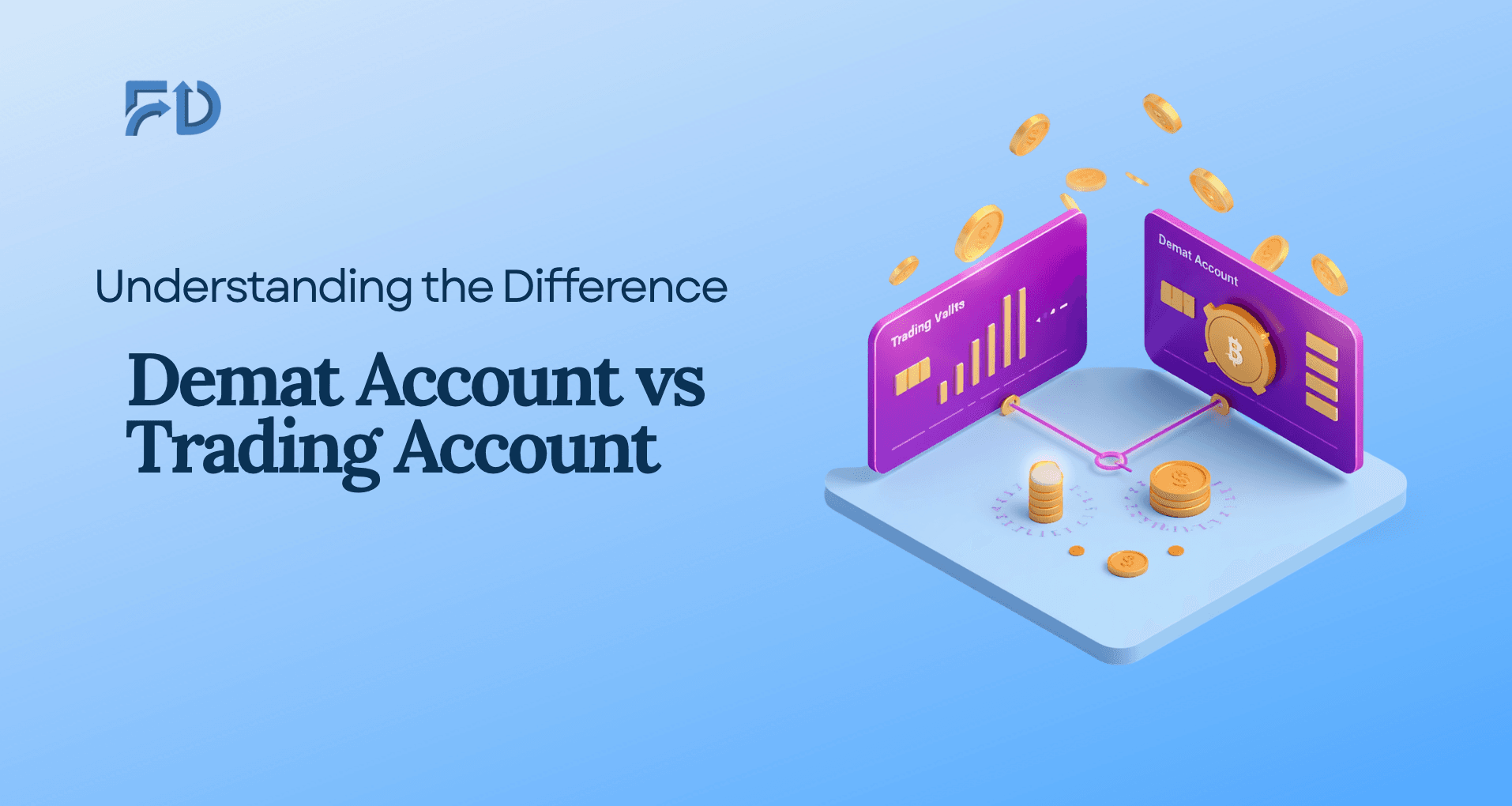
Your Trading account is like your wallet - it's what you use to actually buy or sell shares. Money goes in, orders go out.
Your Demat account is like your digital locker - once you buy shares, they sit safely in this locker. No physical certificates, no paperwork. Just a secure digital record of everything you own.
You need both to invest in the stock market. They work together, but they serve very different purposes.
What Is a Demat Account?
Demat is short for Dematerialised. Before 1996, shares were physical paper certificates - imagine receiving a printed document every time you bought 10 shares of a company. Messy, right?
Today, all shares are held in digital (dematerialised) form. Your Demat account is where these digital shares are stored after you buy them. It's maintained by depositories - either NSDL (National Securities Depository Limited) or CDSL (Central Depository Services Limited).
Think of NSDL and CDSL as the two giant government-regulated vaults in India where all investor share holdings are ultimately recorded.
What Is a Trading Account?
A Trading account is your gateway to the stock exchange - the NSE or BSE. When you want to buy or sell shares, you place an order through your Trading account. It connects your bank account (money) with the stock exchange (where buying and selling actually happens).
Without a Trading account, you cannot place a single buy or sell order.
How Do They Work Together? - Priya's Story
Meet Priya, a 26-year-old teacher from Pune who has just decided to start investing. She opens an account on First Demat and gets both a Demat and a Trading account linked together (this is standard with most brokers today).
Here's what happens when Priya buys 5 shares of Infosys:
Priya logs into her Trading account and places a buy order for 5 shares of Infosys at ₹1,500 per share (total ₹7,500).
The order goes to the NSE through her Trading account.
The trade is executed. ₹7,500 is debited from her linked bank account.
Within T+1 day (one settlement day), those 5 Infosys shares land in her Demat account - safe and sound in her digital locker.
Now when Priya sells those shares a year later, the process reverses. The shares leave her Demat account and money arrives in her bank.
Demat vs. Trading Account - Key Differences
Feature | Demat Account | Trading Account |
Purpose | Stores your shares digitally | Used to buy or sell shares |
Analogy | Digital locker | Wallet |
Maintained by | NSDL or CDSL (depositories) | Your broker (e.g., First Demat, Zerodha, Groww) |
Required for | Holding shares after purchase | Placing buy or sell orders |
Linked to | Trading account | Bank account + Demat account |
Annual charges | Yes (AMC - Annual Maintenance Charge) | Usually free or minimal |
Do You Always Need Both?
For stock market investing - yes, always. You cannot hold shares without a Demat account and you cannot buy or sell without a Trading account.
The good news? Most brokers in India (First Demat, Zerodha, Groww, Upstox, Angel One) open both accounts simultaneously as a 3-in-1 setup (bank + Demat + Trading), so you don't have to manage them separately.
One Thing to Keep in Mind
Your Demat account has an Annual Maintenance Charge (AMC) - usually between ₹300 and ₹750 per year depending on your broker. Even if you don't trade actively, this charge applies as long as you hold shares. Think of it like rent for your digital locker.
FAQ
1. Can I have a Demat account without a Trading account?
- Yes, technically. If you only want to hold shares already transferred to you (for example, shares received as a gift or through an IPO allotment), you don't strictly need a Trading account. But to actively buy or sell, you need both.
2. Can I have multiple Demat accounts?
- Yes. You can open Demat accounts with different Depository Participants (DPs) - your broker acts as a DP. However, most investors manage just fine with one.
3. Is my money stored in the Demat account?
- No. Your Demat account holds only shares or securities - not cash. Cash stays in your linked bank account.
4. What is a DP (Depository Participant)?
- A DP is simply an intermediary, your broker, who connects you to NSDL or CDSL. You don't deal with the depository directly. Your broker handles it.
5. Are Demat accounts safe?
- Yes. They are regulated by SEBI (Securities and Exchange Board of India) and backed by NSDL or CDSL, which are government-supervised bodies. Your holdings are secure even if your broker shuts down.
6. Does it cost money to open these accounts?
- Opening charges vary by broker. Many brokers today offer free account opening. The recurring cost is the Demat AMC, which is typically charged annually.
7. What happens to my shares if my broker closes down?
- Your shares are safe. They are held with NSDL or CDSL - not with the broker. You can transfer them to another broker's Demat account without any loss.